Showing posts with label Analogue Systems. Show all posts

Tuesday, May 10, 2011

The Little Putney


Ever since I've been into synthesis, I was fascinated by the odd looks and sounds of EMS instruments.
Some time back I met Constantin through the release of the excellent The Synthi Group VOL.2 compilation. We soon discovered we have lots of things in common music wise, a similar approach to electronic music production, similar tastes in music and the same immoderate passion for EMS instruments.
Constantin is the happy owner of a lovely Synthi A and an AKS. We sometimes play together and each time he brings his machines along to my place, the passion grows stronger. Not only the passion grows stronger, but also the frustration because EMS instruments are so rare and they go at such crazy prices these days.
That frustration made me search for alternatives in the SDIY world, and I found some... But, lacking the necessary competences, time and finances to build an EMS clone, I had to go for another solution.
All of a sudden it all became clear to me, I had all the modules necessary to assemble a hardware emulation at hand, within my Eurorack system. I already had the possibility to patch up my Eurorack system in an EMS like configuration with my FriFri Deluxe patch matrix . I pushed that idea a little further by taking those modules out of that general Eurorack context, to create a self contained, autonomous and independent instrument... this is how the Little Putney was born, my take at a hardware emulation of the EMS VCS3.


Let's start with the cabinet. The design I made was to recall the distinctive VCS3 silhouette, without being an exact replica. So, I'm off to the DIY store to get some wood and stuff to build a cab...
Here we go :

The bottom part :


With the upper part :


Testing the modules fit :


The first attempt at staining the cab is not satisfactory, the tint is too "red" :


After a couple of sanding sessions and a few layers of "Wenge" staining, this is a more appropriate finish. Also incorporated the backpanel with power supply and busboard, that was taken from an Analogue Systems RS-15 case, and fitting the bottom panel :


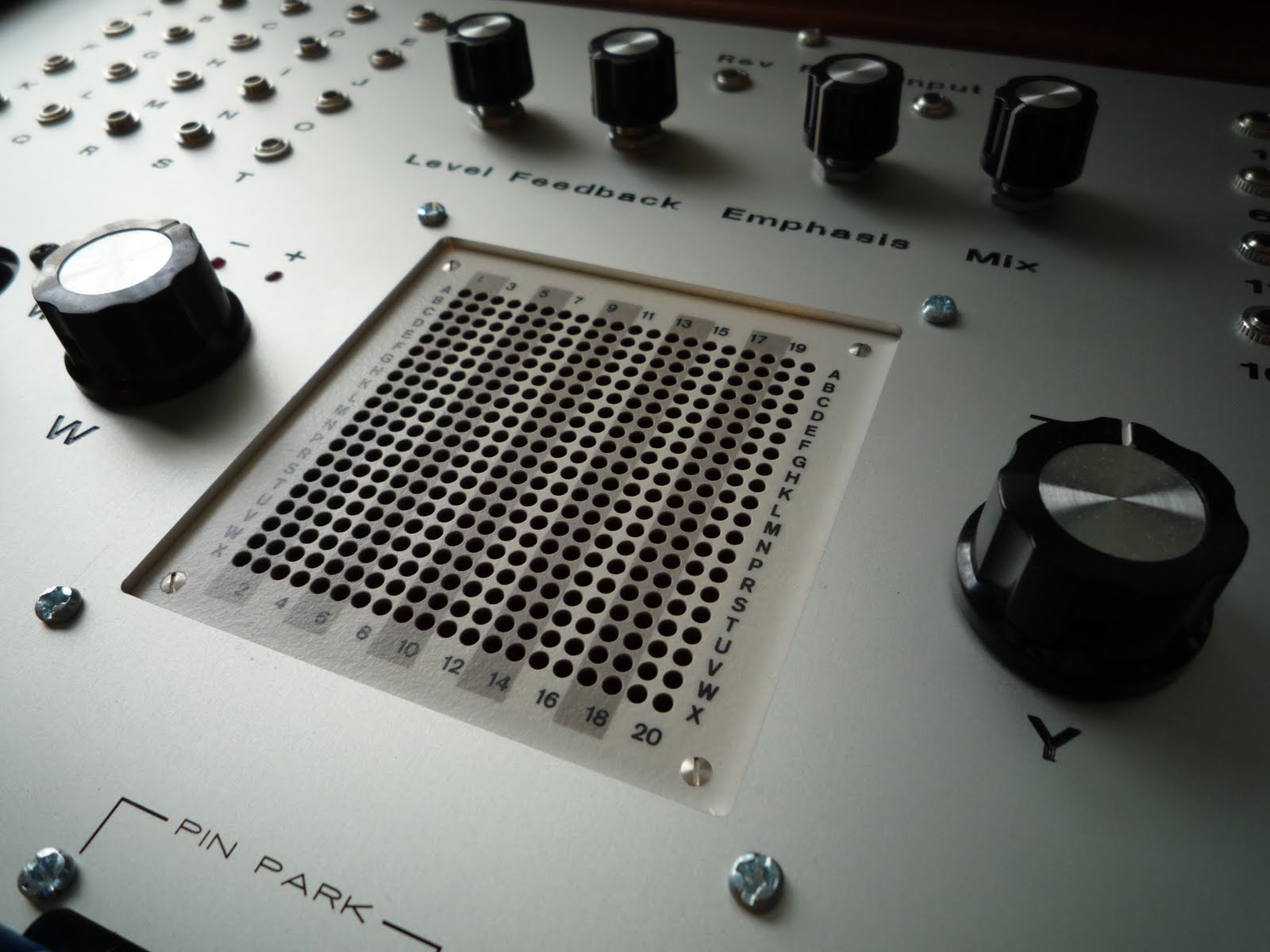
A VCS3 hardware emulation would not be complete without a patch matrix, a joystick and a spring reverb. So, once again, I did a design for a panel with Front panel designer and had it made by Schaeffer AG . The panel is designed to hold a 20x20 matrix by Ghielmetti, a 10x10 matrix as patch pin holder, two Doepfer A-174-1 joysticks, a Doepfer A-199 spring reverb, 20 input jacks to the matrix and 20 output jacks from the matrix.




Fully assembled and ready to roll, at last !


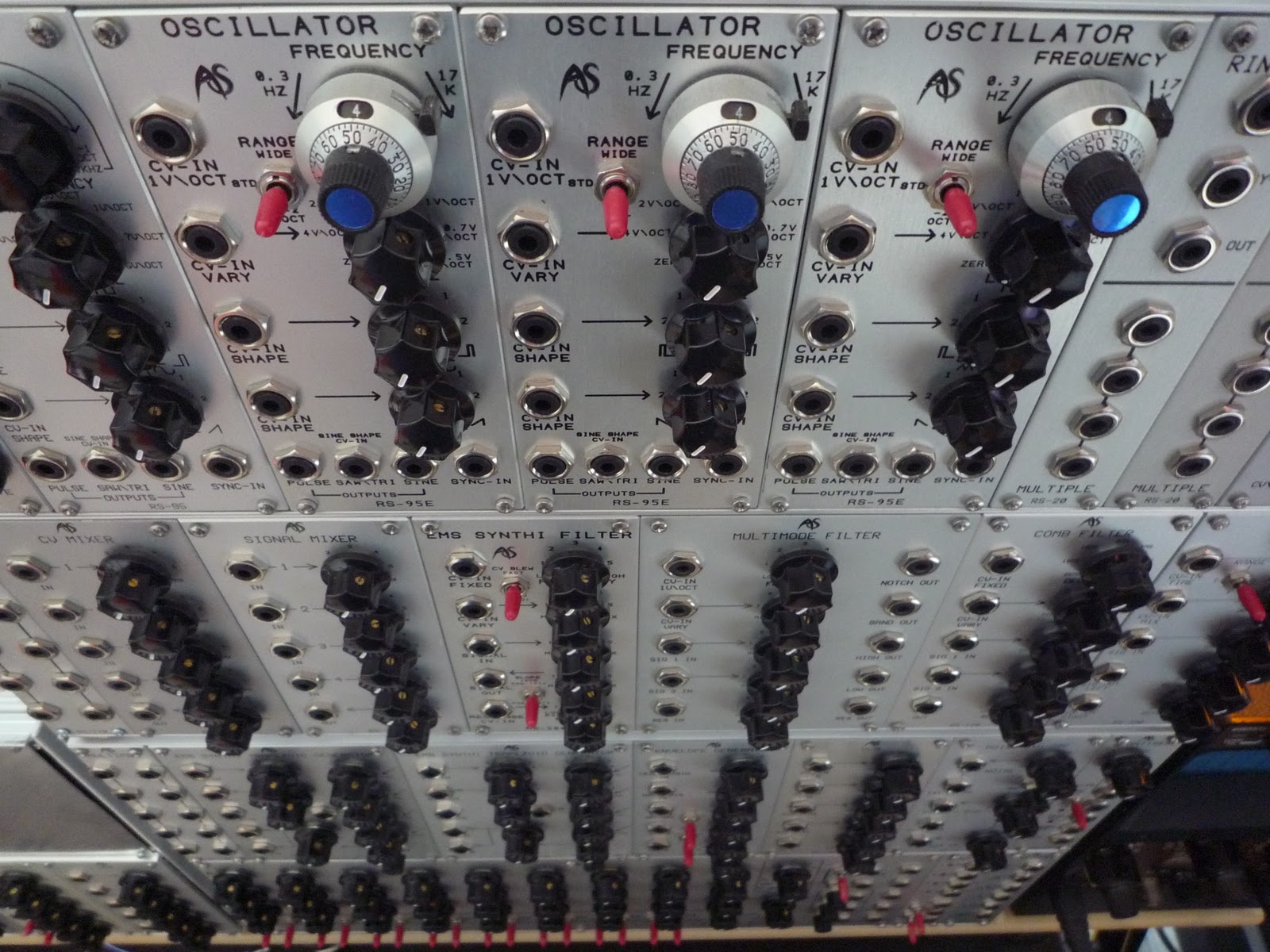
Now for the details of the Analogue Systems module selection, from top to bottom and from left to right :

1x RS-420 Octave controller
3x RS-95e VCO
1x RS-500e EMS Synthi filter
1x RS-20 Ring modulator/multiple
1x RS-510e EMS Synthi trapezoid generator
1x RS-40 Noise, S&H, clock
1x RS-70 Inverter/preamp
1x RS-165 Audio signal mixer
1x RS-190 Meter/inverter
1x RS-390 Mono in / stereo out echo
2x RS-180 VCA


This configuration is to cover a maximum of EMS functionality with some left out but with some add-ons that are only available to owners of modded Synthis/VCS3s like osc sync, variable waveshape on all waveforms, selectable 18dB/24dB slope on the filter, switchable slew on the cutoff, bipolar trapezoid output, etc...

Results are sonically convincing, even though I'm aware that this synth does not, and never will, sound the same as a genuine EMS synth because the magic of the EMS sound resides in the particular interaction between modules, the quirkyness of their respective responses and the "quality" of the components used for the circuits...for example the "sound" of the VCA's
or the reverb driver circuit ! 

The reverb tank is mounted on the back, outside the cab, to prevent it picking up transformer hum from the power supply.


Here he is for his first night out, with his friends TTE & Moisturizer.


And finally, back home, with some new and slightly smaller knobs to replace the old Eagle fluted that were a bit large and hiding some of the panel graphics.


Next step will be the redesign of the bottom panel. I will sacrifice the left joystick to implement 9 passive attenuators to control the amplitude of the oscillator waveform outputs. Also, I intend to design a single panel to hold the Analogue Systems modules and thus reinforce the visual unity between upper and bottom panels, as the original panels differ in color depending on the batch and some of the legending wears off.

Stay tuned !

Sunday, March 27, 2011

Icing on the cake

I like my music to be quite raw, barebone and untreated. But there are some times when some processing is needed to create depth and notion of space, to create particular ambiences and enhance the "grain" of the sound, to create rhythmic or special effects.

My preference definitely goes to analogue, "classic vintage" technology, that provides deep, warm and lush sounds in opposition to digital, which is more accurate and precise, more versatile but sonically less interesting...at least to my taste.

About 18 years ago, I started with some multi-effects like the Ensoniq DP/4, Boss SE-50 and Lexicon Vortex. All very capable and decent machines, but these were quite soon to be replaced by dedicated analogue processors and pedals.

The effect I most often use in my music is delay, and more specifically tape delay. There's nothing like the organic, self oscillating feedback sound or the fading echoes of a tape delay for that "psychedelic" touch in a production.
The first machine I had (until last week) was a Roland RE-201 Space Echo tape delay/spring reverb


Followed by a modified Evans ES-5 Sound Creator, with Sound-on-Sound capability (which I also sold some time ago). This one was a real oddity and produced some amazing Lo-Fi sounds.


Then came this marvelous Fulltone Tube Tape Echo. Excellent dynamics and wonderfully rich tones. A bit pricey but worth every cent.


With the Space Echo I got the taste of spring reverb and that's how I came to sell it, in favor of a dedicated tape delay and a dedicated spring reverb. The TTE fills in the tape delay part and, two days ago, I acquired this lovely Knas Ekdahl Moisturizer, a stand alone spring reverb with CV control. The springs are mounted on top of the housing so they can be "played". The Moisturizer also sports a built in LFO and multi mode filter, which makes it quite a special and unique unit. This one is soon to be modified for an even wider range of sounds (keep an eye on my Mod page...)


The above mentioned units are all for dedicated, external treatments. Inside the modular I don't have that much dedicated effects modules.

The Oakley Sound Systems Overdrive, which does exactly what its name suggests, ranging from subtle overdrive to full on distortion. Perfect to add a little grain and grit to a VCDO or a VCF. This is more a sound processor than an effects unit...

The Analogue Systems RS-390 is a voltage controllable mono in/stereo out echo with a very special sonic identity. It can deliver blurry, hazy sound clouds or quite clean and slowly bouncing echoes. It is also capable of very short delays to get into chorus/flanger territory.


The Doepfer A-199 SPRV spring reverb ( left bottom corner of the case ) with the reverb tank mounted outside the case to reduce hum and noise induced by the proximity of the power supply, and to be able to "play" the springs like on the Moisturizer.


 These are soon (I hope) to be complemented by Analogue System's RS-400 analogue phase shifter, the Pittsburgh Modular BBD Analogue Delay and Synthesis Technology's E560 Deflector Shield digital frequency shifter/phase shifter/ring modulator and the E580 Resampling Mini Delay.

Sunday, February 13, 2011

The never ending story...

Each time new modules arrive it is the excitement of reshuffling the setup, mounting and dismounting modules to fit the cabs, trying to keep the balance between aesthetics & visual symmetry, ergonomy and functionality. Time consuming, quite laborious but lots of fun. Once that is done, it is time to explore the functionality and possibilities of the newcomers... even more fun!

The following is a photo report on the evolution of my setup that shows the various incarnations of my modular over the past months up to it's current state. Enjoy !

08/2009
Some EMS flavors added

12/2009
A dedicated cab for each brand and the arrival of the indispensable oscilloscope


01/2010
Arrival of some badly wanted Make Noise modules, the QMMG and the Wogglebug


02/2010
An overall shot of the studio in those days and a close up on some dual channel oscilloscope madness


04/2010
Got myself a second Analogue Systems RS-15 case with some modules, also some more Livewire, a Tiptop Audio Z8000 matrix sequencer and a Roland System-100M 184 polyphonic 4CV/Gate keyboard


05/2010
Yes! I finally got a second hand Livewire Dual Cyclotron and replaced all the knobs by 19mm Eagle fluted ones

Ooops ! This is not mine ?! ... it is my friend Constantin's amazing dual EMS setup with his SDIY interface... beautiful !! I couldn't resist posting this one

Added a third RS-15 with some sequencing goodies

Yes! those knobs look and feel quite good

06/2010
At last... the Livewire cab is completed with a second AFG... thanks Nav ... massive  !

07/2010
Preparing to incorporate my forthcoming SDIY FriFri Deluxe patch matrix/attenuator bank. Notice the two reverb tanks mounted externally, on top of the cabs

10/2010
Here it is, installed and all patched up (more on this in my SDIY page)

A broader picture of the whole lot, unpatched

02/2011
This latest setup saw the addition of some Plan B, Oakley and Synthesis Technology modules in the top right cab


3/4 2011


The latest additions to my setup are two STG Soundlabs modules, the Wavefolder and the Sea Devils filter.


Both circuits are based on Yves Usson designs.

The first, as its denomination suggests, will "fold" any incoming signal. By doing so, the Wavefolder will output a more complex signal and produce new harmonic content. Obviously , it works best on simple waveforms of audio signals. There's an Offset control that will determine at what "level" of the waveform the folding will occur. For instance, by adjusting the Offset appropriately, one could apply folding only onto the positive period of a bipolar signal. Fold mix control makes the balance between the original signal  and the folded signal. Gain control is a VCA on the input stage of the folding circuit.
Voltage control is provided for Gain (with attenuator) and Offset.
Basic application of the Wavefolder is to render a rather dull waveform more harmonically rich.
Wave folding can produce comparable results to those obtained with wave shaping or wave multiplying.
The Wavefolder is not a module I use very often but its use can be very rewarding if set up correctly.

The Sea Devils filter is a diode ladder design inspired by the circuit found on second generation EMS Synthi A and AKS, with a 24dB slope.
As its pedigree suggests, that filter has bags of character, it "sings" very well at high resonance settings,  with a huge frequency range and it tracks quite well to 1V/Oct...that makes the SDF a great sine oscillator to provide powerful bottoms with good definition and crispy, precise highs.
Also, it responds very well to fast, audio rate frequency modulation.
Volume drop at high resonance settings is not too obvious and there are lots of sweet spots just before and after the point of self oscillation.
At high input levels, the SDF delivers smooth saturation, which is very nice.
Voltage control is provided for Resonance, there are two 1V/Oct frequency modulation inputs and there's one scalable frequency modulation input with attenuator.
All of this makes the SDF my favorite in my current setup. I love it even more than the Analogue Systems RS-500e, which is also an EMS based diode ladder filter circuit.

Both modules are 14hp and benefit of roomy front panels. They are quite deep, so they won't fit into a skiff. Panel control layout is clear but positioning of the control input jacks can be somewhat confusing as they are not placed right next to or under their respective parameter. Build quality is excellent and working with these modules proves to be a very satisfactory experience.

Looking forward to grab a Post Lawsuit filter ...